
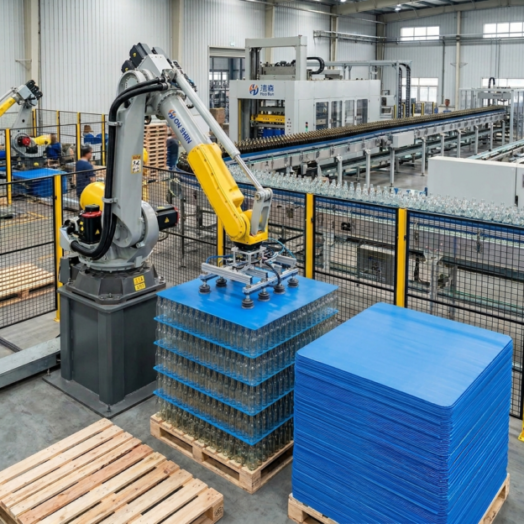
In the era of Industry 4.0, efficiency is measured in milliseconds. Robotic arms, vacuum pick-and-place systems, and automated palletizers work in perfect harmony to move goods at blistering speeds. However, even the most expensive robotic system is only as good as the materials it handles. For years, the Achilles’ heel of automated palletizing has been the humble layer pad. Whether made of paper-based cardboard or low-grade plastic, standard pads often suffer from a critical flaw: electrostatic cling. In a high-speed environment, static electricity causes Corrugated Layer Pads to “stick” to one another, leading to double-pick errors, machine-tripping, and production downtime. At Onshin, we have re-engineered our Corrugated Layer Pads to meet the rigorous demands of modern smart factories.
1. The Anatomy of a Robot-Friendly Layer Pad
To understand why our Corrugated Layer Pads are the preferred choice for automated lines, one must look at the fusion of material science and precision engineering.
The Anti-Static Breakthrough
Electrostatic attraction occurs when friction during shipping and handling builds up a charge on the surface of plastic sheets. In automated stacking, this charge causes vacuum systems or mechanical grippers to grab two or more pads at once. Our Corrugated Layer Pads feature a permanent anti-static surface treatment. This is not a temporary coating that wipes off; it is integrated into the polymer matrix during the extrusion process. This treatment dissipates surface charges almost instantly, ensuring that when the robotic suction cup approaches, it grabs exactly one pad—no more, no less.
Structural Rigidity for Vacuum Stability
Robotic grippers rely on stable vacuum suction to lift layer pads. If a pad is too flexible or lacks structural rigidity, the vacuum cup may deform the surface, causing the pad to sag, lose suction, or misalign during placement. Our Corrugated Layer Pads utilize a high-density polypropylene (PP) core that provides excellent weight-to-stiffness ratios. This ensures the pad remains flat and stable, even when subjected to the high-velocity movements of modern robotic arms.
2. Eliminating Misalignment in High-Speed Palletizin
Misalignment is the primary cause of automated production bottlenecks. When a layer pad shifts by even a few millimeters, the entire palletizing stack can become unstable, leading to collapsed loads during transit. By implementing our precision-cut Corrugated Layer Pads, manufacturers can achieve consistent edge-to-edge alignment.
- Tolerance Control: Every sheet is die-cut to exact specifications, ensuring zero variation in size.
- Surface Texture: The surface of our Corrugated Layer Pads provides enough friction to hold products in place, yet is smooth enough to allow for precise sliding during automated adjustments.
3. Cost-Efficiency and Sustainability: A B2B Perspective
Investing in high-quality Corrugated Layer Pads is a strategic decision that impacts the bottom line. Traditional cardboard pads degrade quickly when exposed to humidity, requiring frequent replacement. Conversely, our PP-based pads are moisture-resistant and chemically inert, making them suitable for long-term reuse.
Furthermore, global industrial standards—such as those upheld by ISO and SGS—increasingly prioritize sustainable, recyclable packaging materials. By transitioning to our durable Corrugated Layer Pads, your company not only optimizes production throughput but also aligns with corporate ESG (Environmental, Social, and Governance) goals. For companies looking to overhaul their internal logistics, we recommend reviewing our comprehensive guide on Logistics Efficiency for additional cost-saving insights.
4. Why Industry Leaders Choose Onshin
With 20 years of manufacturing experience and an annual production capacity of 10,000 tons, Onshin is a leader in the global supply of Corrugated Layer Pads. We understand that every production line is unique, which is why we offer custom engineering services to adapt our pad thickness, density, and anti-static levels to your specific hardware.
[Call to Action]
Ready to optimize your robotic palletizing process? Stop letting electrostatic cling and structural instability compromise your efficiency. Partner with Onshin to integrate high-performance Corrugated Layer Pads into your production line today.
[Explore Our Full Catalog of Industrial Plastic Products]
[Contact Our Technical Team for a Free Consultation]